
TDS on Business Payments: Section 194C, 194J (₹50k Limit), 194I, 194Q & New Income Tax Act 2025 Sections Guide (FY 2026-27)
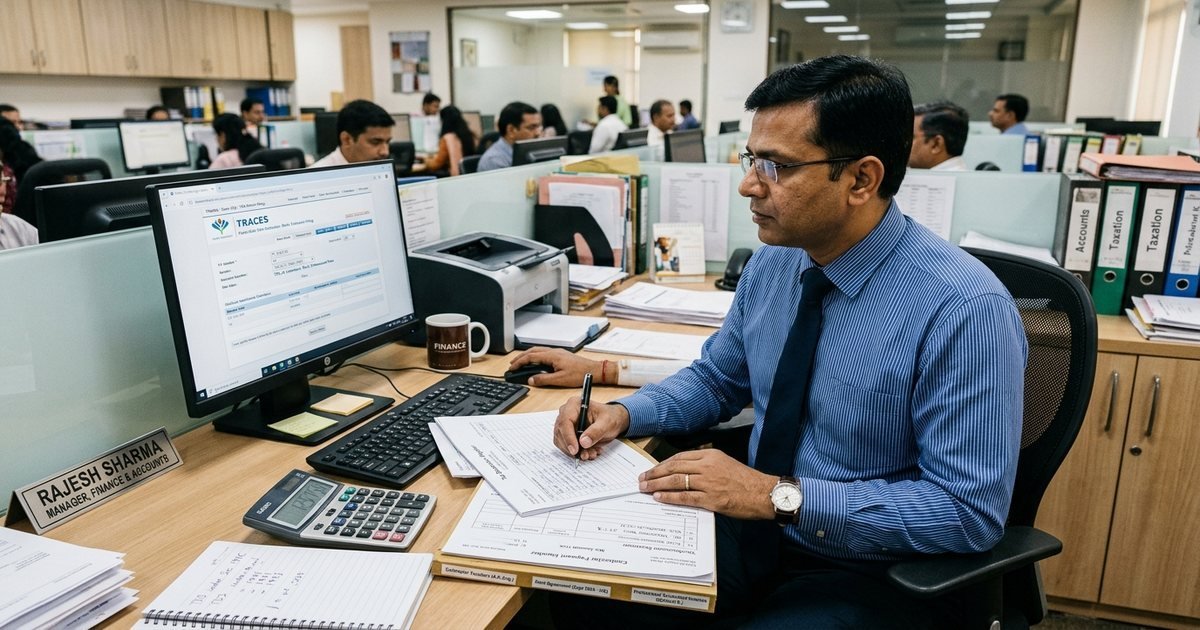
For FY 2026-27 (AY 2027-28), commercial TDS provisions are updated across both the Income Tax Act, 1961 and the streamlined Income Tax Act, 2025: Section 194J has its de-minimis threshold enhanced to ₹50,000 per financial year (10% for professional services, 2% for technical services FTS, while director sitting fees remain at ₹0 threshold with 10% withholding from Re 1). Section 194C applies to contractors at 1% (Individual/HUF) and 2% (Company/LLP/Firm) with thresholds of ₹30,000 single / ₹1,00,000 aggregate (0% for transporters with <=10 trucks under 194C(6)). Section 194I applies to rent at 10% (land/building) and 2% (plant/machinery) above ₹2.40 Lakhs. Section 194Q applies to high-value goods purchases at 0.1% on amounts above ₹50 Lakhs for buyers with turnover > ₹10 Cr. Under CBDT Circular 23/2017, TDS is deducted only on base taxable value excluding itemized GST. Failure to deduct triggers 30% expenditure disallowance under Section 40(a)(ia).
Complete Guide to Business TDS Withholding Under Income Tax Act 1961 vs. Income Tax Act 2025 (FY 2026-27)
Tax Deducted at Source (TDS) is a fundamental statutory withholding mechanism in India that places legal responsibility directly on business payers to deduct tax at source when incurring vendor, contractor, rent, or technical expenses and remit it directly into the Central Government account. With the legislative transition between the historic Income Tax Act, 1961 and the modern, restructured Income Tax Act, 2025, understanding both old section numbers and the updated statutory framework is essential for every entrepreneur, CFO, and accounts desk.
A key headline change for FY 2026-27 (AY 2027-28) is the enhancement of the de-minimis threshold under Section 194J from ₹30,000 to ₹50,000, alongside rationalized 2% rate slabs for technical retainers, contract operations, and commission payments.
Failing to deduct TDS or delaying deposits into the government treasury triggers an automatic 30% disallowance of the entire expense under Section 40(a)(ia), mandatory interest under Section 201(1A), per-day late fees under Section 234E, and severe prosecution under Section 276B.
Need professional guidance for corporate tax withholding and quarterly return filings? Explore our Comprehensive Accounting & Tax Compliance Solutions or speak directly with our chartered tax team.
1. Statutory TDS Rate Chart & Thresholds for FY 2026-27 (AY 2027-28)
The table below outlines the core commercial withholding sections applicable for all business transactions in Financial Year 2026-27, reflecting all updated statutory thresholds:
| Old Section (IT Act 1961) | Nature of Business Payment | Single Transaction Limit | Annual Aggregate Threshold | Normal TDS Rate (With Valid PAN) | Non-PAN Rate (Sec 206AA) | Quarterly Return Form |
|---|---|---|---|---|---|---|
| 194C | Works Contract & Subcontract (Individual / HUF Contractor) | ₹30,000 | ₹1,00,000 | 1% | 20% | Form 26Q |
| 194C | Works Contract & Subcontract (Company, Firm, LLP, AOP) | ₹30,000 | ₹1,00,000 | 2% | 20% | Form 26Q |
| 194C(6) | Goods Transport Agency (GTA) owning ≤ 10 trucks with PAN & Declaration | Nil | Nil | 0% (NIL TDS) | 20% | Form 26Q (Exempt) |
| 194J(a) | Fees for Professional Services (CA, Legal, Medical, Architect, Engineers) | - | ₹50,000 per FY (Enhanced) | 10% | 20% | Form 26Q |
| 194J(b) | Fees for Technical Services (FTS) & Software / IT Consultancy | - | ₹50,000 per FY (Enhanced) | 2% | 20% | Form 26Q |
| 194J(1)(ba) | Director Remuneration, Sitting Fees & Commission (Non-Salary) | ₹0 (From Re 1) | ₹0 (No Threshold) | 10% | 20% | Form 26Q |
| 194I(a) | Rent for Plant, Machinery, Industrial Equipment, or Generator Sets | - | ₹2,40,000 per FY | 2% | 20% | Form 26Q |
| 194I(b) | Rent for Commercial Land, Office Premises, Building, or Furniture | - | ₹2,40,000 per FY | 10% | 20% | Form 26Q |
| 194-IB | Rent paid by Individuals/HUF not liable to tax audit (> ₹50k/month) | ₹50,000 / month | ₹6,00,000 per FY | 2% (Rationalized) | 20% | Form 26QC (Challan) |
| 194H | Commission or Brokerage (Sales, Property, Consignment Agency) | - | ₹15,000 per FY | 2% (Rationalized) | 20% | Form 26Q |
| 194M | Contract / Professional / Commission payments by Non-Audit Ind/HUF | - | ₹50,00,000 per FY | 2% (Rationalized) | 20% | Form 26QD (Challan) |
| 194Q | Purchase of Goods (Buyer Turnover > ₹10 Cr in preceding FY) | - | ₹50,00,000 per FY | 0.1% (on excess) | 5% (Proviso 206AA) | Form 26Q |
| 194-O | E-Commerce Operator payment to E-Commerce Participants | - | ₹5,00,000 (Ind/HUF) | 0.1% (Rationalized) | 5% | Form 26Q |
| 194R | Value of Any Benefit or Perquisite arising from Business/Profession | - | ₹20,000 per FY | 10% | 20% | Form 26Q |
2. Income Tax Act 1961 vs. Income Tax Act 2025: TDS Cross-Reference & Section Mapping
As India transitions toward the Income Tax Act, 2025, direct tax provisions have been systematically restructured into streamlined, logical withholding codes. Understanding both the legacy section numbers (used in six decades of jurisprudence and existing ERP templates) and the newly codified 2025 architecture is crucial for tax audits, vendor contracts, and legal drafting.
Comprehensive Cross-Reference Mapping Table
| Subject Matter / Payment Category | Historic Citation (Income Tax Act, 1961) | Modern Codification (Income Tax Act, 2025) | FY 2026-27 Threshold Limit | Applicable Withholding Rate | Key Statutory Rationale |
|---|---|---|---|---|---|
| Payments to Contractors & Job Workers | Section 194C | Simplified Contract Withholding Code | ₹30,000 single / ₹1,00,000 aggregate | 1% (Ind/HUF) / 2% (Entities) | Retains works contract scope & GTA exemption |
| GTA Transporter Exemption | Section 194C(6) | Goods Transport Exemption Proviso | Nil (≤ 10 trucks) | 0% (NIL TDS) | Requires PAN + valid declaration format |
| Professional Services (CA, Legal, Medical) | Section 194J(a) | Professional Remuneration Code | ₹50,000 per FY (Raised from ₹30,000) | 10% | Threshold expanded to ease compliance for small practitioners |
| Technical Services (FTS) & IT Consultancy | Section 194J(b) | Technical Services & Software Code | ₹50,000 per FY (Raised from ₹30,000) | 2% | Lower 2% rate protects tech startup working capital |
| Director Sitting Fees & Remuneration | Section 194J(1)(ba) | Director Governance Withholding | ₹0 (Deductible from Re 1) | 10% | Zero threshold prevents corporate tax leakage |
| Plant, Machinery & Equipment Rent | Section 194I(a) | Movable Asset / Equipment Hire Code | ₹2,40,000 per FY | 2% | Industrial machinery, servers, generator sets |
| Office, Land & Building Rent | Section 194I(b) | Immovable Property Tenancy Code | ₹2,40,000 per FY | 10% | Commercial leases, corporate headquarters |
| Rent by Non-Audit Individuals/HUF | Section 194-IB | Non-Audit Residential / Commercial Rent | ₹50,000 per month | 2% (Reduced from 5%) | Deducted using Form 26QC; no TAN required |
| Commission or Brokerage | Section 194H | Agency & Brokerage Withholding Code | ₹15,000 per FY | 2% (Reduced from 5%) | Substantially reduced to curb litigation |
| Purchase of High-Value Goods | Section 194Q | High-Value Commercial Goods Withholding | ₹50,00,000 per FY | 0.1% | Overrides Seller TCS under Section 206C(1H) |
| E-Commerce Participant Settlements | Section 194-O | Digital Platform / E-Commerce Code | ₹5,00,000 (Ind/HUF) | 0.1% (Reduced from 1%) | Boosts liquidity for online retail sellers |
| Business Perquisites & Incentives | Section 194R | Commercial Benefits & Perquisites Code | ₹20,000 per FY | 10% | Dealer conferences, foreign trips, corporate gifts |
| Non-Furnishing of PAN (Default Rate) | Section 206AA | Higher Rate Default Enforcement | Nil | 20% (5% for 194Q) | Penal rate for unverified or missing PAN |
| Non-Filers of ITR (Specified Persons) | Section 206AB | Non-Filer Accelerated Withholding | ₹50,000 aggregate TDS/TCS | Twice normal rate or 5% | Targets chronic non-filers of income tax returns |
Why Was the Section 194J Threshold Increased to ₹50,000?
Under the historic 1961 provisions, the ₹30,000 threshold for professional and technical fees had remained unchanged for over a decade despite significant inflation. Small startups and MSMEs making minor payments to freelance designers, IT support vendors, and legal consultants faced disproportionate compliance burdens—requiring TAN registration, monthly challan deposits, and quarterly Form 26Q filings for modest sums. Elevating the threshold to ₹50,000 per financial year provides immediate relief to small businesses and gig-economy professionals while retaining high-value tax tracking.
3. Deep Dive: Section 194C (Contractors & Transporters)
Scope of 'Work' Under Section 194C
Under Section 194C, 'work' includes:
- Advertising contracts (media, hoardings, digital agency retainer contracts).
- Broadcasting and telecasting, including production of programs for such broadcasting.
- Carriage of goods and passengers by any mode of transport (other than railways).
- Catering services for corporate events, cafeterias, and staff canteens.
- Manufacturing or supplying a product according to the requirement or specification of a customer by using material purchased from such customer (job work / contract manufacturing). However, if the material is purchased from an unrelated third party, it is treated as a contract for sale of goods and falls outside Section 194C.
The Dual Threshold Test
- Single Bill Rule: If a single invoice exceeds ₹30,000, TDS is mandatory on that invoice.
- Aggregate Annual Rule: Even if every individual invoice is below ₹30,000 (e.g. 5 invoices of ₹25,000 each), the moment the cumulative total in the financial year crosses ₹1,00,000, TDS becomes deductible on the entire cumulative value from the first invoice onward.
Transporter NIL TDS Exemption under Section 194C(6)
Transport payments represent a substantial portion of logistics expenses for manufacturing and trading firms. Under Section 194C(6):
- No TDS is deducted on payments to a Goods Transport Agency (GTA) contractor if the contractor provides their PAN along with a signed declaration stating they do not own more than 10 goods carriages at any time during the financial year.
- Mandatory Reporting in Form 26Q: The payer is legally required to include the transporter's name, PAN, and declaration details in the quarterly Form 26Q return under the 'Nil Deduction under Section 194C(6)' code. Failure to report in 26Q will invalidate the exemption.
4. Section 194J: Navigating the 10% vs. 2% Rate Dilemma & the ₹50,000 Threshold
One of the most litigated areas during income tax scrutiny is the classification between Section 194J(a) and Section 194J(b):
Professional Services (10% TDS) vs. Technical Services FTS (2% TDS)
- 10% Professional Services (194J(a)): Applies exclusively to professions notified under Section 44AA: Legal, Medical, Accountancy, Architectural, Engineering, Interior Decoration, Authorized Representative, and Film Artists. Retainer fees paid to practicing CAs, advocates, management consultants, and architectural designers attract 10% TDS above the ₹50,000 threshold.
- 2% Fees for Technical Services (FTS) & Royalty (194J(b)): Covers managerial, technical, or consultancy services rendered through automated systems, IT infrastructure, cloud hosting, software development, SaaS platform customization, and AMC for servers/hardware. The statutory rate was rationalized to 2% above the ₹50,000 threshold to eliminate working capital strain on IT and technology vendors.
- Director Sitting Fees (194J(1)(ba)): Payments to non-executive or independent directors for attending board meetings, committee sittings, or advisory commissions attract 10% TDS with NO minimum threshold (deductible on even a ₹5,000 sitting fee).
Pro Tip for Accounts Desks: Require your IT, software, and marketing vendors to explicitly state "Fees for Technical Services under Section 194J(b) - Rate 2%" on their invoices, rather than generic 'Professional Charges', to safeguard against audit queries.
5. CBDT Circular No. 23/2017: TDS Deduction on Base Value vs. GST
Many businesses mistakenly deduct TDS on the gross invoice amount including GST, creating friction with vendors and freezing excess cash in tax withholdings. The Central Board of Direct Taxes (CBDT) issued Circular No. 23/2017 (F. No. 275/59/2012-IT(B)) clarifying the rule beyond doubt:
The Statutory Rule
Wherever the GST component (CGST, SGST, IGST, UTGST) included in the amount payable to a resident vendor is indicated separately on the invoice, TDS shall be deducted STRICTLY on the base value excluding GST.
Mathematical Illustration
Assume a management consultant issues a tax invoice as follows:
- Base Professional Fees: ₹2,00,000
- 18% IGST (separately itemized): ₹36,000
- Total Gross Invoice Amount: ₹2,36,000
Correct TDS Calculation:
- TDS Section: 194J(a) at 10%
- Applicable Base: ₹2,00,000 (excluding IGST)
- TDS Amount to Deduct: ₹20,000
- Net Payout to Consultant: ₹2,36,000 - ₹20,000 = ₹2,16,000
*Note:* If the vendor provides a consolidated bill of ₹2,36,000 without separating GST, the payer is statutorily compelled to deduct 10% on the entire ₹2,36,000 (₹23,600 TDS).
6. Section 194Q vs. Section 206C(1H): Purchase vs. Sale of Goods Hierarchy
When high-value purchase and sale transactions cross ₹50 Lakhs between large corporate entities, dual applicability of TDS (Section 194Q) and TCS (Section 206C(1H)) arises:
Priority Matrix and Hierarchy Rules
- Thresholds:
- Buyer: Turnover in preceding FY > ₹10 Crores.
- Seller: Turnover in preceding FY > ₹10 Crores.
- Transaction: Aggregate purchase/sale value > ₹50 Lakhs in the current FY.
- The Golden Precedence Rule: Under Section 194Q(5), if both 194Q (TDS by buyer) and 206C(1H) (TCS by seller) apply simultaneously, Section 194Q takes absolute precedence.
- Buyer's Responsibility: The buyer must deduct TDS at 0.1% on the purchase amount exceeding ₹50 Lakhs at the time of credit or payment. The seller will NOT collect TCS.
- If Buyer Fails to Deduct: If the buyer turnover is under ₹10 Crores (so 194Q does not apply), but the seller's turnover exceeds ₹10 Crores, the seller must collect TCS at 0.1% under Section 206C(1H) at the time of receipt.
- Non-PAN Rate under 194Q: If the seller fails to provide PAN, the TDS rate rises to 5% (not 20%, as per the specific proviso under Section 206AA).
7. The Terrifying Impact of Section 40(a)(ia): 30% Expenditure Disallowance
Section 40(a)(ia) is the most punitive provision in business taxation. It disallows 30% of any expenditure payable to a resident if:
- Tax was deductible under Chapter XVII-B but was not deducted, OR
- Tax was deducted during the financial year, but was not paid on or before the due date of filing ITR under Section 139(1) (e.g. 31st October of Assessment Year for corporate/audit assessees).
Financial Impact Example
- Total Professional Fees paid: ₹30,00,000
- TDS Applicable (10%): ₹3,00,000 (inadvertently missed or not deposited)
- Disallowed Amount (30%): ₹9,00,000
- Corporate Tax Rate with surcharge & cess: ~25.17%
- Extra Tax Payable Immediately: ₹9,00,000 * 25.17% = ₹2,26,530
- In addition, statutory interest under Section 201(1A) at 1% to 1.5% per month accrues from day one until actual deposit.
*Relief Provision:* When the defaulted TDS is deducted and deposited in a subsequent financial year, the disallowed ₹9,00,000 is allowed as an expense in that subsequent year.
8. Mandatory Compliance Calendar & Due Dates
A. Monthly Challan ITNS 281 Payment Cycle
- April to February Deductions: Due on or before the 7th day of the following month (e.g., September TDS must be deposited by October 7th).
- March Deductions: Extended statutory due date is 30th April.
- Mode of Payment: Mandatory online payment through the Income Tax e-Filing portal via Net Banking, NEFT/RTGS, or authorized debit card using Challan ITNS 281.
B. Quarterly Form 26Q Return Due Dates
- Quarter 1 (April to June): Due by 31st July
- Quarter 2 (July to September): Due by 31st October
- Quarter 3 (October to December): Due by 31st January
- Quarter 4 (January to March): Due by 31st May
C. Form 16A TDS Certificate Issuance
Every deductor is legally obligated to download digitally signed Form 16A certificates from TRACES and furnish them to payees within 15 days from the due date of filing the quarterly return (15 August, 15 November, 15 February, and 15 June).
9. Double-Entry Accounting in Tally Prime / ERP
To ensure flawless reconciliation during statutory audit, finance teams should post standard double-entry journal vouchers for TDS transactions:
Step 1: Expense Booking with TDS Deduction
```text
Date: 25-Oct-2026
Journal Voucher (F7):
Debit: Professional Fees Account (Expense) ₹1,00,000
Debit: Input CGST Account (Current Asset) ₹9,000
Debit: Input SGST Account (Current Asset) ₹9,000
Credit: TDS Payable u/s 194J (Current Liability) ₹10,000
Credit: Vendor ABC & Co (Sundry Creditor) ₹1,08,000
(Being professional fees booked with 10% TDS on base value as per CBDT Cir 23/2017)
```
Step 2: TDS Deposit to Central Government
```text
Date: 06-Nov-2026
Payment Voucher (F5):
Debit: TDS Payable u/s 194J (Current Liability) ₹10,000
Credit: HDFC Bank Current Account ₹10,000
(Being TDS remitted to Govt treasury via Challan ITNS 281 BSR Code 0510344 / Challan No 10293)
```
Step 3: Payout to Vendor
```text
Date: 10-Nov-2026
Payment Voucher (F5):
Debit: Vendor ABC & Co (Sundry Creditor) ₹1,08,000
Credit: HDFC Bank Current Account ₹1,08,000
(Being net vendor payment released after TDS withholding)
```
10. 10-Point Internal TDS Audit Checklist for Finance Desks
Before closing books of accounts at the end of every month, verify these 10 compliance checkpoints:
- PAN Master Verification: Has every new vendor PAN been verified for 'Active & Inoperative' status and checked on the 206AB Compliance Portal?
- Threshold Monitoring: Are cumulative payments under Section 194J tracked against the updated ₹50,000 threshold across all professional and technical ledgers?
- 194C vs 194J Boundary: Have IT maintenance retainers been separated from pure legal/accounting retainers to ensure correct 2% vs 10% rate application?
- GTA Exemption Dossier: Are copies of valid PAN and signed <=10 goods carriages declarations collected for every transporter claiming 0% TDS?
- Director Payments: Has 10% TDS been applied from the very first rupee on director sitting fees and commissions?
- Commercial Rent Dual Check: Is rent on machinery separated at 2% while premises rent is deducted at 10% above ₹2.40 Lakhs?
- Advance Payment Withholding: Has TDS been deducted on vendor advance payments at the time of payment before the bill is booked?
- Year-End Provisions: Are 31st March year-end expense provisions subjected to TDS deduction in the month of March?
- Challan ITNS 281 Reconciliation: Have monthly challans been mapped to specific vendor deductee records in your TDS software?
- TRACES Form 26AS Matching: Have all Form 16A certificates been downloaded and shared with vendors within the 15-day statutory window?
For end-to-end corporate tax compliance, TAN registrations, and quarterly Form 26Q filings, connect with D BIZ Solutions Corporate Tax Advisors.
Calculate Exact TDS Withholding & Tally Accounting Entries
Test any vendor payment scenario: select statutory sections (194C, 194J, 194I, 194Q), toggle PAN availability, apply CBDT Circular 23/2017 GST exclusion, and view instant net payouts with copy-ready journal vouchers.
Invoice & Payee DetailsSection 194J(1)
Services rendered by professional practitioners such as legal, medical, engineering, accountancy, technical consultancy, or interior decoration.
Payment & TDS Settlement VoucherFY 2024-25 / 2025-26
Complete TDS Rate Chart as per Income Tax Act (FY 2025-26 & AY 2026-27)
Statutory rates reflecting all provisions applicable for Budget 2026 and AY 2026-27.
| Section | Nature of Payment / Service | Individual / HUF | Company / Others | Exemption Threshold | Return Form |
|---|---|---|---|---|---|
| Sec 194J(1) | Professional & Legal Fees (CA, Lawyer, Doctor, Architect, Consultant) Professional & Legal | 10% | 10% | ₹50,000 per financial year (Enhanced limit) | Form 26Q |
| Sec 194J(1) | Technical Services (FTS) & IT / Software Consultancy IT & Technical Services | 2% | 2% | ₹50,000 per FY (Enhanced limit / 2% rate) | Form 26Q |
| Sec 194J | Call Center Operations & BPO Support Services IT & Technical Services | 2% | 2% | ₹50,000 per financial year (Enhanced limit) | Form 26Q |
| Sec 194J(1)(ba) | Director Remuneration, Sitting Fees & Commission (Non-Salary) Corporate Governance | 10% | 10% | No basic threshold (TDS applies on all amounts from ₹1) | Form 26Q |
| Sec 194C | Works Contract / Subcontract (Civil, Catering, Advertising, Printing) Contractor & Works | 1% | 2% | Single bill > ₹30,000 OR Aggregate in FY > ₹1,00,000 | Form 26Q |
| Sec 194C(6) | Goods Transport Agency (GTA) with PAN Declaration (≤ 10 carriages) Contractor & Works | 0% | 0% | 0% Nil TDS upon furnishing PAN declaration of owning ≤ 10 goods carriages | Form 26Q |
| Sec 194-I(b) | Rent on Commercial Land, Office Space, Building or Furniture Rent & Real Estate | 10% | 10% | ₹2,40,000 per financial year (₹20,000/month) | Form 26Q |
| Sec 194-I(a) | Rent on Plant, Machinery, Industrial Equipment or Generator Sets Rent & Real Estate | 2% | 2% | ₹2,40,000 per financial year | Form 26Q |
| Sec 194-IB | Rent paid by Individuals/HUF not liable to Tax Audit (> ₹50k/month) Rent & Real Estate | 2% | 2% | Rent > ₹50,000 per month (Budget 2024: 2% rate) | Form 26QC |
| Sec 194H | Commission or Brokerage (Sales Agency, Property Brokers, Consignment) Commission & Brokerage | 2% | 2% | ₹15,000 per FY (Budget 2024: 2% rate) | Form 26Q |
| Sec 194-O | E-Commerce Operator payment to E-Commerce Participants E-Commerce & Digital | 0.1% | 0.1% | ₹5 Lakhs for Ind/HUF with PAN; Nil for others (Budget 2024: 0.1%) | Form 26Q |
| Sec 194Q | Purchase of Goods exceeding ₹50 Lakhs (by Buyer with turnover > ₹10 Cr) Goods & Supply | 0.1% | 0.1% | 0.1% on purchase value exceeding ₹50 Lakhs in FY | Form 26Q |
| Sec 194M | Payments to Contractors/Professionals by Ind/HUF (Not under Tax Audit) Payments by Ind/HUF | 2% | 2% | Aggregate payments > ₹50 Lakhs in FY (Budget 2024: 2%) | Form 26QD |
| Sec 194A | Interest other than Interest on Securities (Unsecured loans, NBFC) Finance & Interest | 10% | 10% | ₹40,000 (₹50,000 for Senior Citizens; ₹5,000 for others) | Form 26Q |
| Sec 194R | Benefit or Perquisite arising from Business or Profession Business Benefits | 10% | 10% | ₹20,000 per financial year | Form 26Q |
1.0% per month or part of a month from the date on which tax was deductible to the date on which tax is actually deducted.
1.5% per month or part of a month from the date on which tax was deducted to the date on which tax is actually paid to the credit of the Government.
If TDS is not deducted or not deposited before the ITR filing due date, 30% of the expenditure is disallowed for corporate income tax.
Frequently Asked Questions

Akash P R
Business Consultant10 Years+ Experience in Startup Consultancy, Direct Tax, Indirect Tax and Compliances • D BIZ CONSULTANCY
Business Consultant with 10 Years+ Experience in Startup Consultancy, Direct Tax, Indirect Tax and Compliances.
Connect with Akash on LinkedInOther Strategic Business Guides
GST Registration Documents in Kerala: How to Avoid Application Rejection
8 min readGST & TaxationGSTR-2B Reconciliation with Purchase Register: How to Match Invoices and Protect ITC
9 min readCompany Law & MCAAOC-4 vs MGT-7: Annual MCA Filing Requirements for Indian Companies Explained
8 min readLLP ComplianceLLP Form 8 and Form 11: Annual Compliance Checklist, Timelines and Late Fee Risks
7 min readLatest Regulatory Bulletins
Speak With Our Senior Business Consultants in Trivandrum & Kochi
D BIZ CONSULTANCY PVT. LTD. provides end-to-end company formation, ROC filings, GST accounting, trademark protection, and statutory compliance. Connect with us for personal advisory at our physical offices or 100% paperless digital onboarding.