
GST Council Recommendations vs Statutory Notifications: When Does a GST Decision Become Enforceable Law?
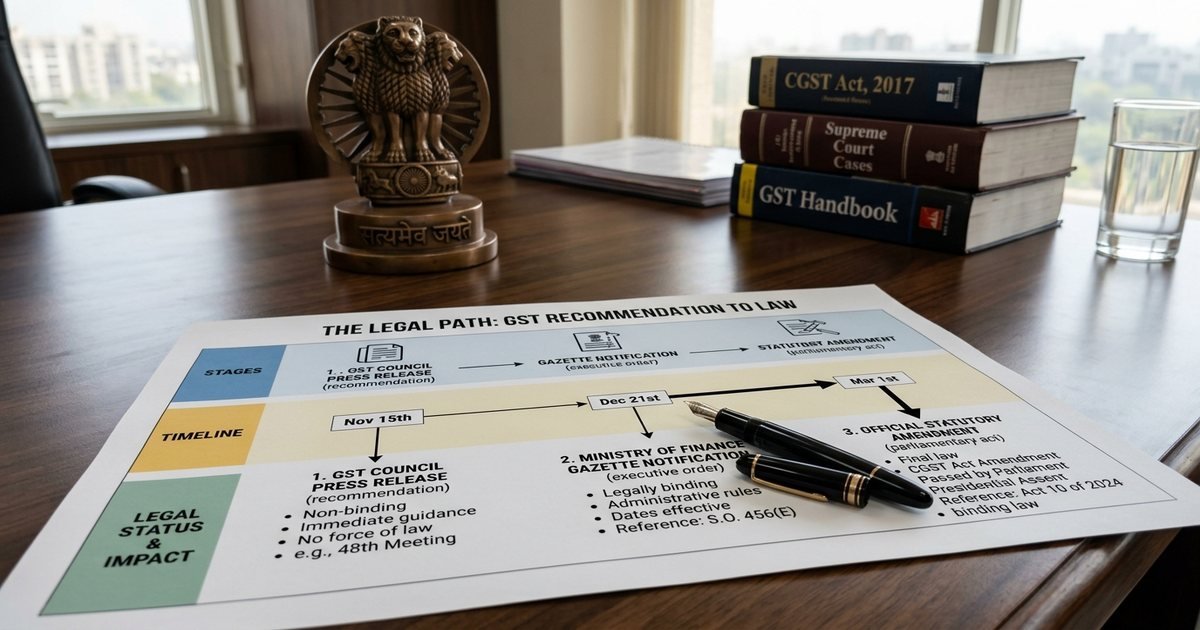
GST Council recommendations do not automatically possess the force of enforceable law. Under Article 279A of the Constitution of India and the landmark Supreme Court ruling in Union of India vs Mohit Minerals (2022), the GST Council is a collaborative constitutional advisory body whose decisions represent recommendations. To become legally enforceable, recommendations must be translated into formal Central Tax, Integrated Tax, or State Tax Notifications issued by the Ministry of Finance and published in the Official Gazette, or enacted through Parliamentary/State legislative amendments. Businesses acting solely on press releases face substantial legal and financial risks.
The Legal Anatomy of GST Decisions: Recommendations vs Enforceable Law
Following every landmark GST Council meeting—such as the recent 57th GST Council Meeting—industry headlines immediately trumpet sweeping tax cuts, decriminalization measures, and procedural reliefs. Business owners, accountants, and CFOs are often eager to immediately update their ERP billing systems, revise invoices, and adjust Input Tax Credit claims.
However, acting prematurely on press releases or news reports is a serious legal trap. In India's constitutional taxation framework, a GST Council recommendation is not enforceable law.
Explore our comprehensive analysis in our GST Advisory & Litigation Support Desk.
1. Constitutional Foundation: Article 279A and the Mohit Minerals Precedent
The Goods and Services Tax Council was established under Article 279A inserted by the Constitution (One Hundred and First Amendment) Act, 2016.
Article 279A(4) mandates that the Council shall make recommendations to the Union and the States on:
- Taxes, cesses, and surcharges to be subsumed;
- Goods and services subject to or exempt from GST;
- Model GST laws, principles of levy, and apportionments;
- Threshold limits of turnover and tax rates.
The Landmark Ruling: *Union of India vs. Mohit Minerals Pvt. Ltd. (2022)*
In this historic judgment, the Supreme Court of India conclusively settled the legal status of the GST Council:
- Persuasive Value: The court held that the recommendations of the GST Council are not unalterably binding on the Union or State legislatures.
- Cooperative Federalism: Parliament and State legislatures possess simultaneous and equal legislative competence to enact GST laws under Article 246A.
- Therefore, Council decisions do not automatically amend the CGST, SGST, or IGST Acts upon conclusion of a meeting.
2. The 4-Stage Transition: How a Recommendation Becomes Law
For a GST Council recommendation to become legally enforceable and binding on taxpayers, it must traverse a strict statutory pipeline:
- Stage 1: Council Deliberation & Press Communique - Consensus is reached by Union and State finance ministers; PIB releases an executive press statement summarizing intentions.
- Stage 2: Legislative Drafting - The Law Committee and Fitment Committee draft legal amendments to rules, rates, and statutory forms.
- Stage 3: Subordinate Legislation & Gazette Notification - CBIC issues official Central Tax / Integrated Tax Notifications under Section 164 published in the Official Gazette of India. For statutory act amendments, Parliament passes a Finance Bill.
- Stage 4: Effective Date Enforcement - The provisions take legal effect on the specific date appointed in the notification.
3. Comparing Legal Instruments in GST
| Instrument | Issuing Authority | Legal Status | Binding Nature | Where Published |
|---|---|---|---|---|
| Council Press Release | Ministry of Finance (PIB) | Informational statement | Not legally binding | PIB Portal |
| Gazette Notification | Central Government / CBIC (Sec 164) | Subordinate delegated legislation | Binding on everyone | Official Gazette of India |
| Departmental Circular | CBIC (Under Section 168) | Administrative clarification | Binding on Tax Officers; persuasive for taxpayers | CBIC Website |
| Statutory Order | Central Government (Removal of Difficulties) | Executive statutory order | Binding within scope | Official Gazette |
4. Practical Rules for Corporate Tax Teams
- Never alter billing engines based on press releases: Wait until the CBIC officially publishes the Central Tax / Integrated Tax rate notification specifying the precise effective date.
- Examine the exact wording of the Gazette Notification: Frequently, the fine print of a notification contains conditions, eligibility exclusions, or transitional dates that differ subtly from informal press statements.
- Circulars clarify but cannot override the Act: If a departmental circular attempts to impose tax or disallow credit contrary to the parent CGST Act, constitutional courts have consistently held that the circular must yield to the statute.
For cutting-edge tax planning, notification tracking, and dispute management, consult the D BIZ Tax Research Desk.
Frequently Asked Questions

Akash P R
Business Consultant10 Years+ Experience in Startup Consultancy, Direct Tax, Indirect Tax and Compliances • D BIZ CONSULTANCY
Business Consultant with 10 Years+ Experience in Startup Consultancy, Direct Tax, Indirect Tax and Compliances.
Connect with Akash on LinkedInOther Strategic Business Guides
GST Registration Documents in Kerala: How to Avoid Application Rejection
8 min readGST & TaxationGSTR-2B Reconciliation with Purchase Register: How to Match Invoices and Protect ITC
9 min readCompany Law & MCAAOC-4 vs MGT-7: Annual MCA Filing Requirements for Indian Companies Explained
8 min readLLP ComplianceLLP Form 8 and Form 11: Annual Compliance Checklist, Timelines and Late Fee Risks
7 min readLatest Regulatory Bulletins
Speak With Our Senior Business Consultants in Trivandrum & Kochi
D BIZ CONSULTANCY PVT. LTD. provides end-to-end company formation, ROC filings, GST accounting, trademark protection, and statutory compliance. Connect with us for personal advisory at our physical offices or 100% paperless digital onboarding.